
Tsuwano is not a place to use as a substitute for Kyoto.
It should not be introduced as “a smaller version” of somewhere more famous, even though it has often been called the “Little Kyoto of the San’in Region.” That phrase may help travelers locate it in their imagination, but it does not explain why Tsuwano deserves the journey. Tsuwano’s real value is different: it is one of the rare castle towns where the traveler can still arrive without feeling that the experience has already been consumed online.
Located in western Shimane Prefecture, close to the border with Yamaguchi, Tsuwano is a small mountain town with a population of a little over 6,000 people. Its official Japan Heritage site describes it as a town preserved through castle-town scenery, nature, old traditions, and cultural events that have continued for centuries.
That scale matters.
Tsuwano is not designed to overwhelm you in one moment. It does not depend on a single giant monument. It does not need the traveler to chase a famous view at a fixed hour. Instead, the town works slowly: a road, a waterway, a roofline, a hillside, a shrine path, a quiet station, a small shop, a curve in the street, a silence between sounds.
This is exactly why Tsuwano should not be searched too deeply before visiting.
Learn how to get there.
Learn where to stay.
Learn how to behave respectfully.
But leave the town itself partially unseen.
Tsuwano has a special relationship with images. Its Japan Heritage story is connected to the Tsuwano Hyakkeizu, a set of one hundred paintings that recorded daily life in the Tsuwano Domain during the Edo period, around 160 years ago. These paintings are not just decoration; they are a way of understanding how memory, townscape, and everyday life overlap here.
That makes Tsuwano unusually suitable for no-spoiler travel.
The town already teaches you that a place can be understood through fragments rather than immediate visual possession. You do not need to see everything in advance. You need only enough context to arrive with attention.
Tsuwano is also a practical choice for foreign travelers. This is important. A hidden destination is not valuable if visitors are left unsupported or if the local environment is not ready to receive them. In Tsuwano, the Japan Heritage Center functions as a tourist information point, and its official access information states that English pamphlets and tourist maps are available in six languages. The center is often recommended as a first stop for visitors.
That does not mean Tsuwano should be treated like a theme park. It remains a small local town. Travelers should move quietly, avoid entering private spaces, respect local routines, and understand that not every sign or conversation will be in English. But the presence of official multilingual information makes Tsuwano more suitable for overseas visitors than many places with similar depth.
Access is also reasonable. Travelers can reach JR Tsuwano Station by taking the JR Yamaguchi Line from Shin-Yamaguchi Station, and Japan’s official tourism site describes the Tsuwano and Masuda area as a destination for travelers seeking Japanese history and culture away from Kyoto’s crowds.
This accessibility is part of the reason Tsuwano is the right choice for this series. It is hidden enough to protect discovery, but not so closed that foreign visitors must force their way into a place unprepared for them.
The best way to visit Tsuwano is not to build a checklist.
Do not reduce it to “castle ruins,” “old streets,” “shrines,” or “traditional scenery.” Those words are useful, but they are too flat. Tsuwano’s appeal is not in confirming labels. It is in sensing how the town sits inside its valley, how history remains present without becoming loud, and how the pace of the place changes the way you look.
If you arrive after studying too many photos, Tsuwano becomes familiar too quickly.
If you arrive with restraint, it becomes an encounter.
That difference matters.
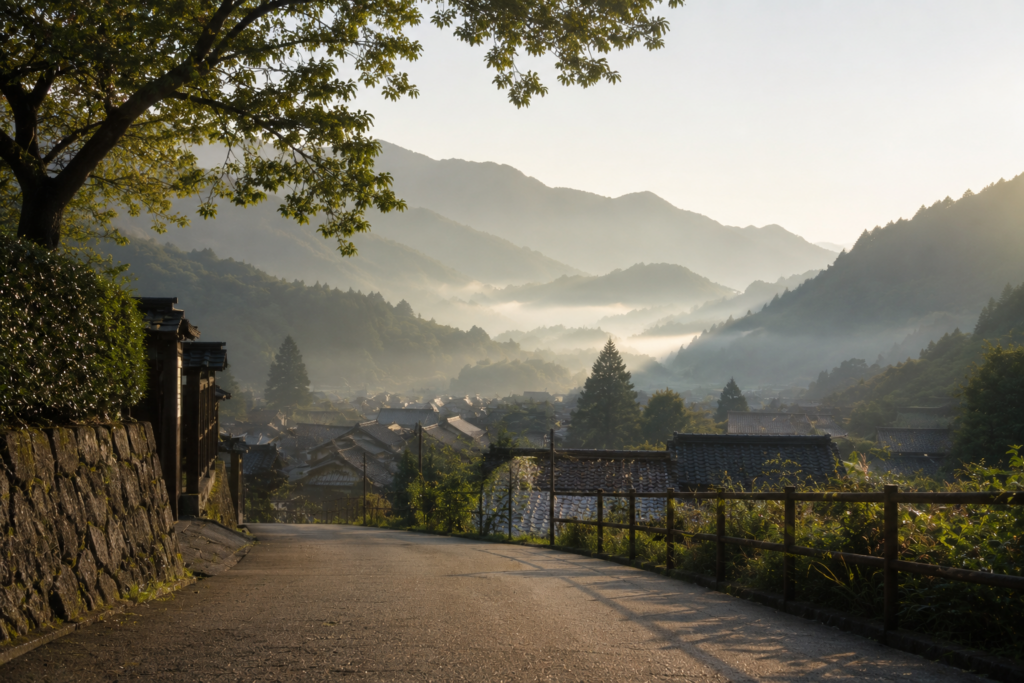
Some Japanese destinations are powerful because they are spectacular. Tsuwano is powerful because it is measured. Its beauty does not ask for instant reaction. It asks the traveler to slow down enough to notice proportion, distance, age, and atmosphere.
For overseas visitors, this may become one of the most important parts of the journey. Tsuwano offers a form of Japan that is neither urban nor remote wilderness. It is cultural, but not crowded. Historical, but still lived in. Photogenic, but better left unspoiled. Accessible, but not overexplained.
That balance is rare.
Before you go, prepare only what protects the trip: train times, lodging, opening hours, weather, and local manners. Begin at the tourist information point or Japan Heritage Center if you want orientation. Then put the phone away as much as possible.
Let the town remain ahead of you.
Let the first street arrive as a first street.
Let the water, hills, roofs, and quietness become real in their own order.
Let Tsuwano introduce itself before the internet does.
Tsuwano is not a place to recognize.
It is a place to meet.