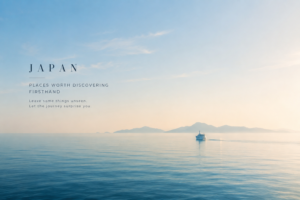

Kunisaki Peninsula is not a backup destination after Kyoto.
It is not a quieter version of somewhere famous.
It is a place that deserves to be chosen for one clear reason: it still allows travel to feel like discovery.
Located in Oita Prefecture, on the northeastern side of Kyushu, Kunisaki is a peninsula of mountains, forests, farming villages, old religious paths, shrines, temples, and stone figures that are not meant to be consumed too quickly. Japan’s official tourism information identifies the area with Rokugo Manzan, a religious culture with around 1,300 years of history, formed through the blending of Buddhism, Shinto, and mountain worship.
That history matters because Kunisaki is not beautiful in a simple way.
It does not depend on one famous view.
It does not reveal itself through a single photograph.
Kunisaki’s power is in accumulation: a road narrowing into trees, a village sitting quietly between fields and hills, the presence of stone, the weight of old belief, the feeling that the mountains are not scenery but part of the spiritual structure of the place.
This is why you should not look too deeply before going.
Search for access.
Search for where to stay.
Search for weather, transport, and safety.
But do not search for every image.
Kunisaki is one of the rare places where too much visual preparation can weaken the journey. If you see the most atmospheric paths, the most famous stone figures, and the most dramatic temple settings before arrival, the trip becomes recognition. You arrive and confirm what the screen already gave you.
That is not the best way to meet Kunisaki.
The best way is to arrive with only a frame, not a finished image.
The frame is this: Kunisaki is a landscape where faith, agriculture, forest, and village life have shaped one another for centuries. The Kunisaki Peninsula Usa area was designated as a Globally Important Agricultural Heritage System in 2013, recognized for an integrated system connecting sawtooth oak forests, reservoirs, agriculture, forestry, and fisheries.
That means the landscape is not decorative.
The fields are not just countryside.
The forests are not just nature.
The reservoirs are not just water.
They are parts of a living system.
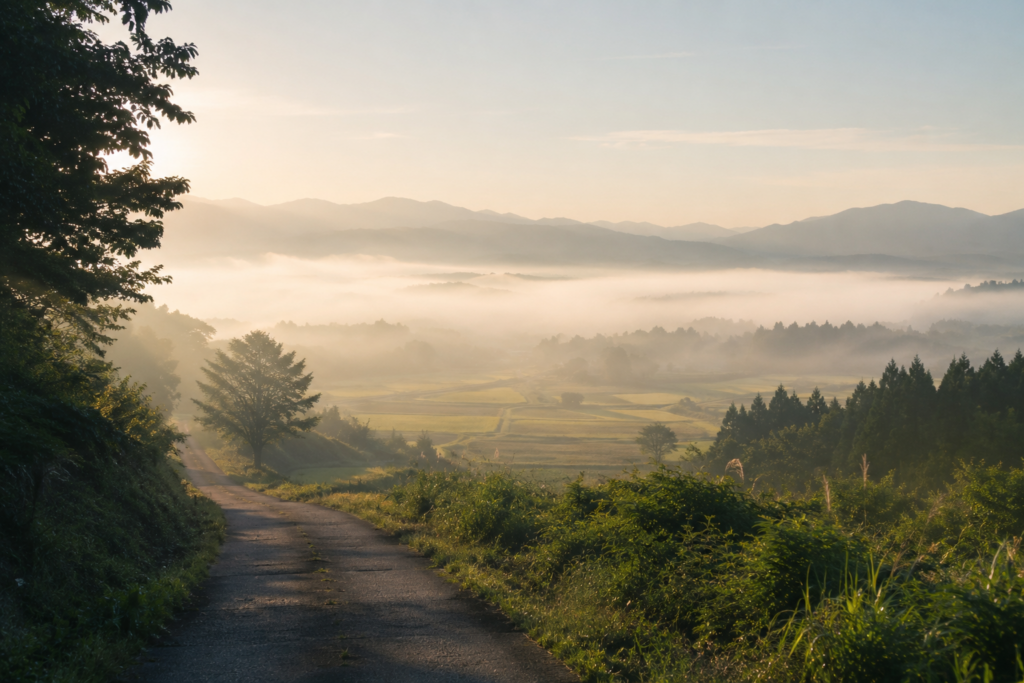
For travelers from overseas, this is the reason Kunisaki is worth the effort. It offers a Japan that cannot be understood through landmarks alone. It is not about standing in front of one famous object and saying you have “done” the place. It is about moving through a region where the sacred, the practical, and the rural still overlap.
Kunisaki also requires intention.
The peninsula’s main stations include Usa and Kitsuki, but Japan’s official tourism guidance notes that travelers who want to explore the interior need a rental car.
This difficulty is not a flaw.
It protects the rhythm of the place.
Kunisaki should not be rushed between famous stops. It should be entered slowly: one road, one forest path, one village, one silence at a time. The reward is not only what you see. It is the feeling that you are being allowed into a landscape that has not rearranged itself entirely for visitors.
That is why Kunisaki fits the idea of no-spoiler travel so well.
You do not go there because it is unknown.
You go because it still has the strength to remain partially unknown.
Leave the exact shapes unseen.
Leave the most powerful views unsearched.
Leave room for the first encounter.
Kunisaki is not a place to preview.
It is a place to meet.