
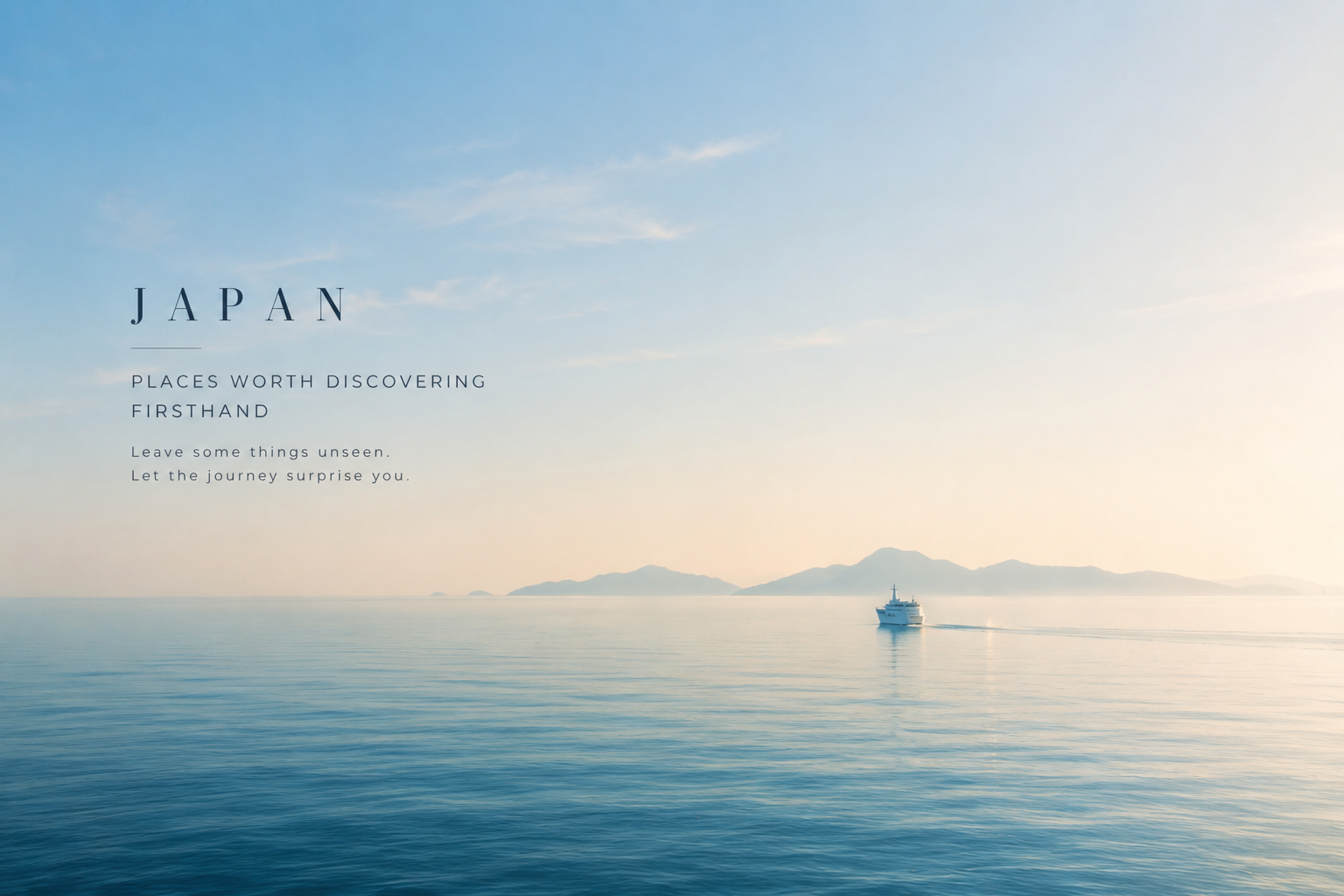
Some places in Japan are best discovered without previewing them first.
Ama Town, on Nakanoshima Island in the Oki Islands, is one of them.
Located in the Sea of Japan, the Oki Islands are part of a UNESCO Global Geopark, a landscape shaped by ancient geological change, island ecosystems, and human life that has adapted to the sea over generations. The islands sit about 40–80 km north of the Shimane Peninsula, and the geopark includes four inhabited islands and many smaller uninhabited ones.
Ama Town is not the kind of destination that overwhelms you immediately.
It does not need a famous skyline, a crowded shopping street, or a single postcard angle. Its appeal is quieter: the feeling of arriving somewhere that has continued at its own rhythm, slightly apart from the speed of mainland Japan.
This is why you should resist the urge to search for too many images before you go.
Part of the value of Ama Town is the first encounter. The color of the water, the shape of the coastline, the scale of the sky, the silence between ferry sounds, the small roads, the shrines, the fields, and the presence of the sea all work better when they are not already familiar. If you arrive with nothing but a few words in your mind, the island has room to surprise you.
Ama Town has a population of around 2,300 people and is known as a place where older traditions and newer ideas coexist. The official Oki tourism guide describes the town with the phrase “Esteeming the old, welcoming the new,” and notes its connection to Emperor Go-Toba, who was exiled to the Oki Islands in the 13th century.
For travelers who want Japan beyond the obvious route, this matters.
Ama Town is not just “beautiful nature.” It is a living island community. The sea is not decoration. The land is not a backdrop. The history is not separated from daily life. You do not visit only to take photos; you visit to notice how a place holds together.
The journey also helps protect the mystery.
You cannot simply step off a city train and arrive. Travelers usually reach the Oki Islands by ferry or fast ferry from Shichirui Port in Shimane or Sakaiminato Port in Tottori. Official tourism information recommends checking ferry times in advance, especially because high-speed ferries require reservations and local transport options can be limited.

That inconvenience is part of the experience.
The crossing gives your mind time to slow down. By the time you reach the island, you have already left the ordinary travel rhythm behind.
Once there, do not rush to “complete” the destination.
Walk. Take a bicycle if conditions are suitable. Sit somewhere without needing to name the view. Let the island reveal itself gradually. Ama Town is relatively flat compared with some other Oki areas, and the official access guide notes that rental bicycles can be a good way to feel the island directly, though buses and taxis require advance attention because services are limited.
The best way to visit Ama Town is not to collect every famous spot.
It is to leave some things unnamed until you stand in front of them.
Before going, learn only what you need: how to get there, where to stay, how to move respectfully, and how to avoid missing the last boat. Leave the exact scenery unseen. Leave the most beautiful places unsearched. Leave space for the moment when the island becomes real.
In an age when travel is often consumed before arrival, Ama Town offers something rare:
a destination that still feels larger than its images.
Go with restraint.
Arrive slowly.
Let the first view belong to you.